Haunted Plantations by Geordie Buxton
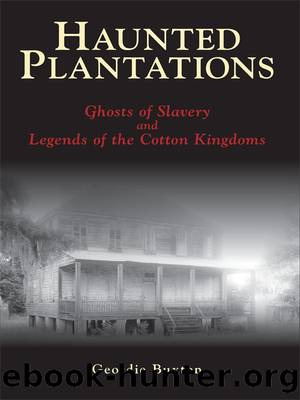
Author:Geordie Buxton
Language: eng
Format: epub
Publisher: Arcadia Publishing
Published: 2011-09-01T00:00:00+00:00
South Carolina Lieutenant Governor William Bull built Sheldon Church on the route of his favorite hunting expeditions. Jemmy and the Stono River slaves marched through this wooded area after burning down a riverfront store in 1739.
My Lords,
Your Lordships Most Obedient
and Most humble Servant
Wm Bull
The Stono Rebellion resulted in a 10-year moratorium on slave imports through Charlestown. Harsher slave codes had already been proposed before Jemmy organized his revolt. On September 29, 1739, twenty days before the Stono rebellion, the Security Act of 1739 was set to take effect. The law was to require all white males to carry arms on Sundays to guard against slave uprisings. Jemmy was a literate slave and was aware of the Security Act. He and the other slaves may have realized that if they did not act to disrupt the slave system before the law was enforced, they may have never had another chance for freedom.
The revolt led to legal and social changes in the South Carolina slave system. The Negro Act of 1740 was passed, which reclassified slaves as âchattel.â The Negro Act made it illegal to teach slaves how to read or write.
South Carolina was a black majority at the time. The fear of further slave rebellions was so great that white freedoms were restricted as well after the Stono rebellion. Slave owners could no longer free their slaves. Taxes were raised on the purchase of slaves to discourage their import, to slow down the growth of the slave population.
William Bull remained in the area, having made the Lowcountry his home. Several years after the Stono rebellion he helped establish the Church of Prince Williamâs Parish near the woods of his favorite hunting expeditions. He was dead and buried beneath a slab at the church by the time the seeds of revolutionâplanted during his encounter with Jemmy in 1739âgrew into something much larger. He likely never imagined a future in which Jemmy and his rebelsâ vision of liberty might come true, but in trying to suppress his greatest fears through stricter laws he inadvertently helped to create that very future.
The British burned Bullâs church in 1780 during the Revolutionary War, but it was reconstructed and renamed Sheldon Church. In 1861, Confederate General Robert E. Lee walked through the church with his men. Four years later, Union General William Tecumseh Sherman burned the church, once again, on his fiery march through South Carolina during the Civil War. As the flames roared over Bullâs grave, perhaps there were still lingering memories of a brutal day in September 1739.
Download
This site does not store any files on its server. We only index and link to content provided by other sites. Please contact the content providers to delete copyright contents if any and email us, we'll remove relevant links or contents immediately.
The Vikings: Conquering England, France, and Ireland by Wernick Robert(84377)
Ali Pasha, Lion of Ioannina by Eugenia Russell & Eugenia Russell(40315)
The Conquerors (The Winning of America Series Book 3) by Eckert Allan W(37892)
The Vikings: Discoverers of a New World by Wernick Robert(37006)
Cecilia; Or, Memoirs of an Heiress — Volume 1 by Fanny Burney(32635)
Cecilia; Or, Memoirs of an Heiress — Volume 2 by Fanny Burney(32010)
Cecilia; Or, Memoirs of an Heiress — Volume 3 by Fanny Burney(31996)
Empire of the Sikhs by Patwant Singh(23135)
The Secret History by Donna Tartt(19291)
Hans Sturm: A Soldier's Odyssey on the Eastern Front by Gordon Williamson(18648)
Cat's cradle by Kurt Vonnegut(15441)
Pimp by Iceberg Slim(14662)
Sapiens: A Brief History of Humankind by Yuval Noah Harari(14458)
Norse Mythology by Gaiman Neil(13457)
Talking to Strangers by Malcolm Gladwell(13438)
Leonardo da Vinci by Walter Isaacson(13407)
4 3 2 1: A Novel by Paul Auster(12505)
Underground: A Human History of the Worlds Beneath Our Feet by Will Hunt(12144)
The Radium Girls by Kate Moore(12089)
